

Understanding Kentucky Medicaid requirements isn’t as straightforward as it sounds
If you’ve started researching Kentucky Medicaid requirements, you’ve probably noticed something frustrating almost immediately.
The answers don’t seem to line up.
One website says you must have almost no money to qualify.
Another says certain assets don’t count.
Someone else tells you that Medicaid will take everything anyway.
It’s enough to make families feel like the rules are impossible to understand.
The truth is that Medicaid eligibility in Kentucky is not a single rule or number. It’s a set of financial and medical requirements that work together, and how those rules apply depends heavily on the situation, especially when long-term care is involved.
This guide explains what the Medicaid requirements in Kentucky actually are, how they apply to seniors who need long-term care, and why understanding them early can prevent costly mistakes for families trying to help a parent or spouse.
The first thing to understand: “Medicaid requirements” depend on the type of Medicaid
When people ask about KY Medicaid requirements, they often assume there is one simple list of qualifications.
In reality, there are several different Medicaid programs, and each has different rules.
For elder law purposes, the program families are usually referring to is long-term care Medicaid, which can help pay for:
- Nursing home care
- Skilled nursing facilities
- Certain home- and community-based services
These programs involve additional financial and eligibility rules that many families don’t expect. More information on 2026 Medicaid Eligibility in Kentucky here.
The three main Medicaid requirements in Kentucky
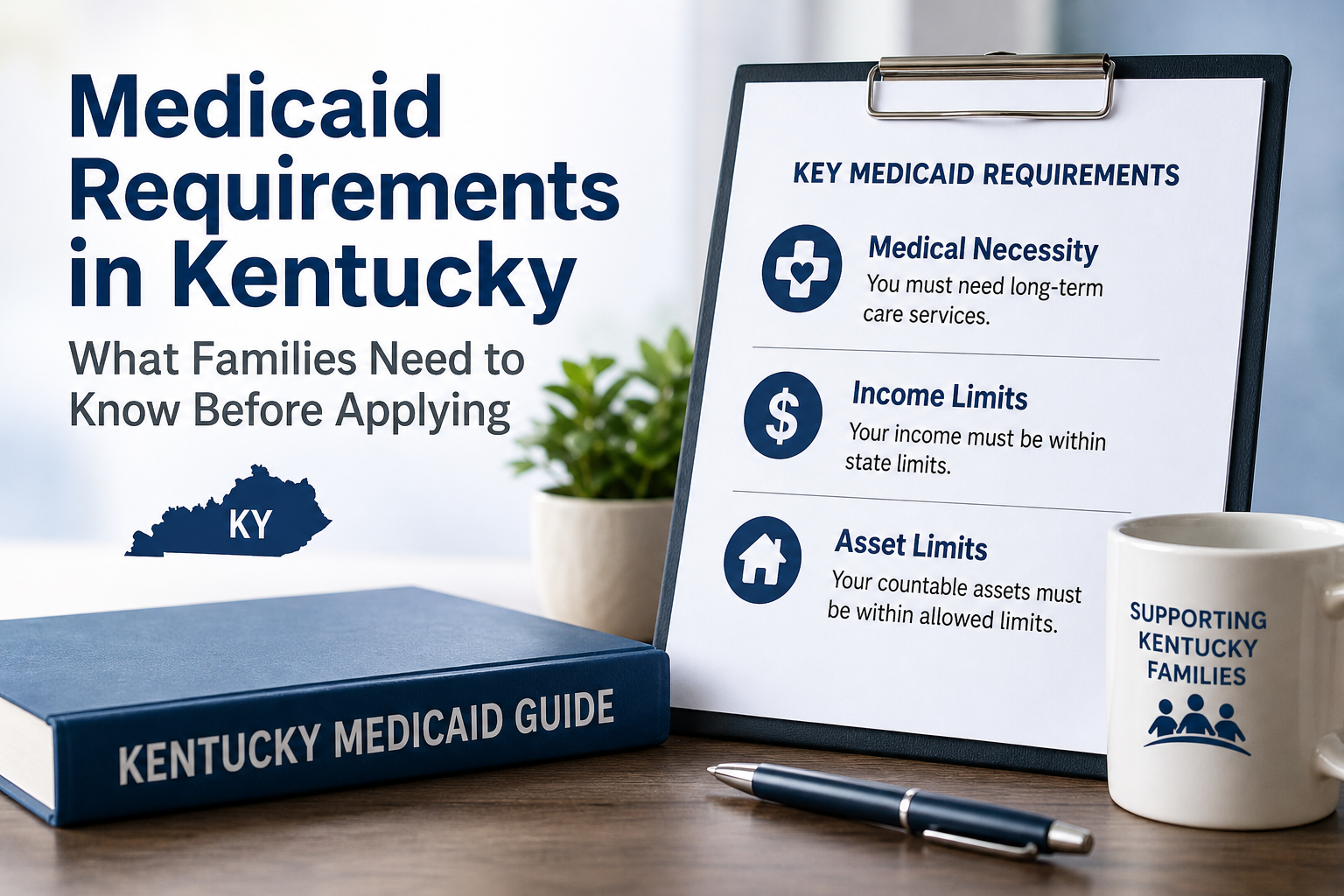
For most long-term care cases, Kentucky Medicaid eligibility focuses on three core areas:
- Medical necessity
- Income limits
- Asset limits
Each of these requirements must be evaluated carefully before applying.
Medical necessity: Medicaid is designed for people who need care
One of the most misunderstood Medicaid requirements is that Medicaid does not simply pay for housing or general assistance.
To qualify for long-term care Medicaid, the applicant must demonstrate a medical need for that level of care.
This is usually determined through assessments showing the individual requires help with activities such as:
- Mobility
- Bathing
- Dressing
- Medication management
- Cognitive supervision
If a doctor determines that someone requires nursing-home-level care, Medicaid may step in to help cover those costs.
Income limits: What Medicaid counts as income
Another major part of Medicaid requirements in Kentucky involves income.
Income may include:
- Social Security benefits
- Pension payments
- Retirement distributions
- Certain annuity payments
Many families worry that if income is above a specific number, Medicaid will automatically deny the application.
Certain income planning strategies may apply, particularly when one spouse requires care and the other spouse remains in the community.
Asset limits: The requirement that surprises families the most
While income is important, asset limits are often the most significant factor in Medicaid eligibility.
Assets may include:
- Checking and savings accounts
- Investment accounts
- Additional real estate
- Certain life insurance policies
- Retirement accounts depending on structure
However, not all assets are treated the same. Some assets may be countable, while others may be considered exempt.
For example, depending on circumstances:
- A primary residence may be exempt
- A vehicle may be exempt
- Personal belongings may be exempt
Understanding these distinctions is critical, because transferring or selling assets incorrectly can create Medicaid penalties.
The role of the five-year look-back rule
Another key part of Medicaid requirements in Kentucky involves the five-year look-back period.
Before approving long-term care Medicaid, the state reviews financial records to determine whether assets were transferred or gifted during the previous five years.
If assets were transferred improperly, Medicaid may impose a penalty period, during which benefits will not be paid.
This is one of the most common reasons families experience delays or unexpected costs.
Medicaid requirements for married couples
Many spouses fear that if one partner needs nursing home care, the other spouse will lose everything.
Fortunately, Medicaid includes spousal protection rules designed to prevent that outcome.
In many situations:
- The spouse living at home may keep the primary residence
- A portion of the couple’s income may be protected
- Certain assets may remain with the community spouse
These protections are important, but they are not always automatically applied. Understanding how they work is a critical part of elder law planning.
What happens if someone does not initially meet Medicaid requirements?
Not meeting Medicaid requirements immediately does not necessarily mean someone will never qualify.
Many families pursue Medicaid planning strategies designed to bring a situation into compliance with the rules.
This may involve:
- Spending down certain assets
- Restructuring income sources
- Evaluating asset protection strategies
- Ensuring applications are filed correctly
The key is to approach these decisions carefully so that families do not unintentionally create penalties or delays.
Why families often struggle to understand Medicaid rules
Medicaid regulations are complex for several reasons.
First, the rules involve both federal and state law, which can make them difficult to interpret without guidance.
Second, the regulations change periodically as programs evolve.
Finally, Medicaid eligibility depends on how rules apply to a specific family’s situation, not just the general guidelines.
This is why two families with very similar financial circumstances may receive very different eligibility outcomes.
Trusted sources for Kentucky Medicaid information
Families researching KY Medicaid requirements often rely on official resources such as:
- Kentucky Cabinet for Health and Family Services (CHFS)
- Centers for Medicare & Medicaid Services (CMS)
These sources provide valuable information about eligibility rules and program guidelines.
However, they are designed to explain regulations, not necessarily to guide families through the practical decisions involved in applying.
Understanding Medicaid requirements can prevent costly mistakes
If you are researching Medicaid requirements in Kentucky, it likely means your family is facing important decisions about care and finances.
The rules surrounding eligibility can be complicated, but they exist to ensure that people who truly need assistance can access it.
Understanding how medical necessity, income limits, and asset limits work together can help families approach the Medicaid process with greater confidence and fewer surprises.
Most importantly, families should remember that eligibility decisions often involve more nuance than simple numbers.
Before applying for Medicaid, make sure you understand your options
If you are considering applying for Medicaid for yourself, a spouse, or a parent, it is worth taking time to understand how the rules apply to your situation.
A short conversation with an elder law attorney can often clarify:
- Whether someone is likely to qualify
- What steps may protect assets
- How to avoid common application mistakes
Schedule a consultation to discuss your family’s situation and explore available options.
Making informed decisions early can help prevent unnecessary stress, delays, and financial loss later.