


A Medicaid asset protection trust (MAPT), commonly called a “Medicaid trust,” is irrevocable and can keep assets out of Medicaid’s count once the 60-month look-back passes. A revocable living trust avoids probate, but Medicaid counts it in full. The two exist for different reasons.
A revocable living trust manages property and keeps it out of probate court. A MAPT is a form of irrevocable trust planning built to set assets apart from long-term care costs and estate recovery.
Choosing a trust while you worry about a loved one’s care is heavy, and learning first is a sound pace. This post follows both trusts through early planning, a care crisis and the period after death. When you’re ready to talk through your family’s options, Elder Law Guidance can help you plan with confidence.
Key Takeaways
- A revocable living trust avoids probate but offers no Medicaid protection: Medicaid counts its assets in full, and Kentucky estate recovery can still reach them.
- A MAPT can keep principal out of Medicaid’s count, but only when it is funded outside the 60-month look-back and the grantor gives up access to principal.
- Time and health decide the fit: with five or more years, a MAPT is realistic, while families with less time or a loved one already in care usually need other planning tools.
How MAPTs And Revocable Trusts Differ
A MAPT and a revocable living trust differ in control. The grantor, the person who creates and funds the trust, keeps full control of a revocable living trust, so Medicaid counts it in full. A MAPT is irrevocable, so its principal leaves the grantor’s countable resources if it was funded outside the 60-month look-back.
The grantor of a MAPT can keep the income the trust earns but cannot take back principal. Under 42 U.S.C. § 1396p(d)(3)(B), any portion of an irrevocable trust that could be paid to the grantor stays countable. Estate recovery under 42 U.S.C. § 1396p(b) and creditor rights under the Kentucky Uniform Trust Code, KRS 386B.5-050, also treat the two trusts differently.
| Test | Revocable living trust | MAPT |
|---|---|---|
| Countable for Medicaid | Yes, in full | Principal not counted if drafted correctly |
| Penalty when funded | None, no transfer occurs | Yes, if within 60 months |
| Estate recovery at death | Reachable under KRS 205.8451 | Generally outside if principal inaccessible |
| Grantor’s creditors | Reachable | Principal generally shielded; retained income exposed |
| Probate avoidance | Yes, if funded | Yes, if funded |
| Grantor access | Income and principal | Income only, no principal |
| Income tax at death | Step-up in basis | Step-up possible if drafted as grantor trust |
Figure 1: The revocable trust helps with probate but not Medicaid, and the MAPT helps with Medicaid only if funded in time. Source: 42 U.S.C. § 1396p(d)(3)(B), (b), (c); KRS 205.8451; KRS Chapter 386B; IRC § 1014.
A simple will falls short here. It does nothing for Medicaid eligibility or estate recovery, and the assets it covers still pass through probate.
Does A Revocable Living Trust Shield Assets?
No, a revocable living trust does not protect assets from Medicaid. The grantor can revoke it and use the assets, so Medicaid counts them under 42 U.S.C. § 1396p(d)(3)(B), and creditors can reach them under KRS 386B.5-050. Medicaid looks at what an applicant could access, not whose name is on the title.
The trust still does useful work. Families use a revocable trust to avoid probate, keep the estate private and let a successor trustee manage property if the grantor loses capacity. A pour-over will catches stray assets left outside it.
Can Medicaid Recover From Revocable Trusts?
Yes, Medicaid can recover from revocable trusts. Kentucky’s estate recovery statute, KRS 205.8451 et seq., reaches non-probate assets, as federal law allows under 42 U.S.C. § 1396p(b)(4). The state’s claim covers benefits paid after age 55.
A revocable living trust does bypass probate for every asset titled in it, but avoiding probate is not avoiding the state’s claim. Assets left outside the trust still need the pour-over will and probate.
Families who want to understand how estate recovery works can see which assets the claim reaches and which planning steps change that.
Does Funding Trigger A Transfer Penalty?
No, funding a revocable living trust does not trigger a transfer penalty. The assets stay countable, so no uncompensated transfer occurs and no look-back clock starts. Some pages online claim the opposite, but retitling assets into a trust the grantor controls is not a gift.
The flip side is that funding gains nothing for eligibility. Moving assets into a revocable living trust now does not shorten the five-year wait a MAPT requires.
How Does The 60-Month Look-Back Treat A MAPT?
The 60-month look-back treats a MAPT funded inside the window as a penalized transfer. Under 42 U.S.C. § 1396p(c), Medicaid reviews transfers made in the 60 months before a long-term care application. The amount transferred, divided by Kentucky’s monthly divisor, equals the months of ineligibility.
That penalty starts only when the person is in care, has applied and is otherwise eligible. Our post on the current penalty divisor gives this year’s figure.
Here is an illustrative example. A single person has savings far above Kentucky’s $2,000 resource limit for a single applicant.
In Scenario A, the savings sit in a revocable living trust. Nearly all of it must be spent on care before Medicaid begins, and at nursing home rates that can take years.
In Scenario B, the savings went into a MAPT six years before the application. The principal is not counted, and no penalty applies.
In Scenario C, the MAPT was funded three years before applying, inside the window. The penalty does not begin until the person is in care and otherwise eligible, so the family can face months with no money and no coverage. Late funding can be worse than none.
Which Assets Belong In Each Trust?
Assets sort into three groups:
- MAPT: assets earmarked for protection that the family can live without, because principal is not available to the grantor.
- Revocable living trust: assets meant for probate-free management, such as accounts the grantor still needs.
- Neither: retirement accounts, where a transfer can cause a taxable distribution, plus vehicles and assets your loved one needs for daily living.
MAPTs And The Home
A MAPT mainly shields a home from estate recovery and equity-cap exposure, not from eligibility counting. In Kentucky the primary residence is generally an exempt resource up to the federal home equity limit. That limit is indexed each year, so families confirm the current figure with the Department for Medicaid Services.
Our guide to owning a home on Medicaid explains the exemption in more depth. Tax treatment also matters. A MAPT drafted as a grantor trust under IRC §§ 671-677 can preserve the § 1014 step-up in basis and the § 121 home sale exclusion, while an outright gift to children carries over the donor’s basis.
A life estate deed transfers the remainder interest, and that transfer counts inside the look-back. A MAPT also transfers the home, but it adds trustee-managed terms and grantor-trust tax treatment.
Which Mistakes Void MAPT Protection?
Six common mistakes leave assets countable or create a tax or eligibility problem:
- The deed was never signed or recorded with the county clerk, so the home never left the owner’s name.
- The trust lets the trustee pay principal to or for the grantor, so that portion stays countable under § 1396p(d)(3)(B).
- The grantor or spouse serves as trustee with broad powers, which has the same effect.
- An IRA or 401(k) was moved into the MAPT, causing a taxable distribution.
- A revocable trust’s “governmental assistance planning” clause was treated as protection, though the assets remain countable.
- The family forgot that income the grantor keeps counts as the grantor’s income for Medicaid.
Miller Trusts And Pooled Trusts Differ From MAPTs
Miller trusts and pooled trusts differ from MAPTs because only a MAPT protects assets. The “Medicaid trust” nickname also gets attached to other tools:
- MAPT: protects assets from Medicaid’s count and estate recovery.
- Miller or Qualified Income Trust: holds income over the limit so an applicant can qualify for nursing home Medicaid.
- First-party special needs trust: holds a person’s own funds under 42 U.S.C. § 1396p(d)(4)(A).
- Pooled trust: a nonprofit-managed trust under § 1396p(d)(4)(C).
- Irrevocable funeral trust: sets funds aside for final expenses.
Families whose income runs over the line often ask about a Miller trust alongside a MAPT. Medicare is not means-tested, so asset protection does not apply to it. Medicare does not pay for custodial long-term care and covers skilled nursing only for a limited period.
Which Trust Fits Your Time Horizon?
The trust that fits depends on time and health. With five or more years and steady health, a MAPT is realistic. With less time, other tools usually fit better, and once your loved one is in care a MAPT no longer applies.
You know your family best, and the choice and pace are yours. The three paths are a runway of five years or more, under five years or declining health, and already in care.
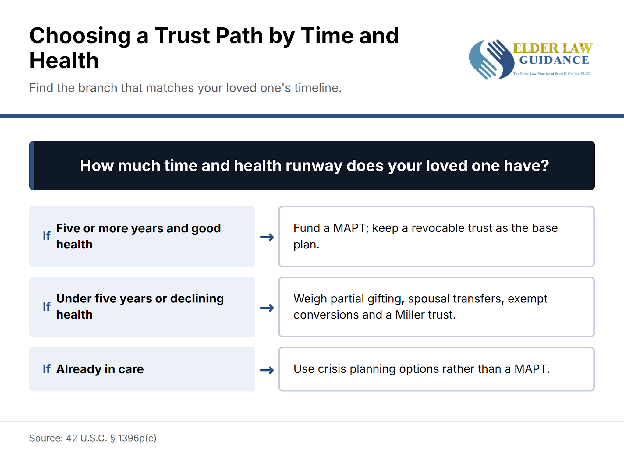
Figure 2: Time and health decide whether a MAPT, other tools or crisis planning fits. Source: 42 U.S.C. § 1396p(c).
Planning With Five Years Or More
With five years or more, the plan funds a MAPT with assets the family can live without and keeps a revocable living trust or other base plan in place. Families fund early, record deeds promptly and choose an independent trustee.
The plan gets reviewed as health changes. The look-back clock cannot be restarted or shortened once funding happens.
Planning When Time Is Short
When time is short, the tools are partial gifting with a return-to-eligibility strategy, spousal transfers, converting countable assets into exempt ones and a Miller trust. Transfers between spouses are exempt from the penalty. That matters for the spouse at home and the community spouse resource allowance, the share of assets the spouse at home may keep.
If your loved one is already in care, the work becomes crisis Medicaid planning rather than a MAPT. Options usually still exist at that stage.
How Do The Two Trusts Work Together?
The two trusts work together as layers rather than rivals. The revocable living trust serves as the hub with a pour-over will, and a MAPT holds the assets set aside for protection.
Both trusts can be grantor trusts, so the grantor reports their income on a personal return. Both can keep the § 1014 step-up in basis, and a properly drafted MAPT can keep the § 121 home sale exclusion. We invite the family’s CPA to review these points.
The design also has to protect the spouse at home, including the resource allowance and spousal transfers. A simple will alone is never enough, because it neither avoids probate nor addresses long-term care costs.
Frequently Asked Questions
What Are MAPT Disadvantages?
A MAPT is irrevocable, and the grantor cannot take back principal. Funding it inside the look-back starts a penalty, and drafting errors leave assets countable. Families weigh these points against what they can live without.
Downside Of A Revocable Trust?
A revocable living trust gives no Medicaid or creditor protection and does not avoid estate recovery. It must be funded to work, and assets left outside it still need probate.
Medicaid With Money In A Trust?
Eligibility depends on the trust type. A revocable living trust counts in full, and an irrevocable trust counts to the extent payments could go to the applicant. Income and asset limits apply either way.
Which Trust Is Safe From Medicaid?
Only a properly drafted and funded MAPT, outside the look-back, removes principal from Medicaid’s count. It is not safe from every risk, and no trust works for a transfer made during a crisis.
Choosing Your Next Step At Your Own Pace
The right trust depends on your loved one’s timeline, health and wishes. Scott and our team keep families updated and work with their financial advisor and CPA on tax implications and the spouse at home. This content is general education, not legal advice for an individual situation.
Scott Collins served in the Army and in ministry before becoming a VA-accredited elder law attorney, and that steadiness shapes how we approach Medicaid planning with families. Start with a Conversation and bring your questions about your loved one’s care to us.